This report was generated using AI under general human direction. At the time of generation, the contents have not been comprehensively reviewed by a human analyst.
Summary of findings
In source-verified, HIV-negative PCP cohorts, adjunctive echinocandin plus TMP-SMX shows a possible but inconclusive mortality benefit versus TMP-SMX monotherapy. The sensitivity-analysis pooled odds ratio is 0.76 (95% CrI 0.43–1.37) (posterior probability of benefit 84%), and the primary analysis is 0.78 (95% CrI 0.31–1.93). The frequentist random-effects estimate (OR 0.75, 95% CI 0.42–1.36) agrees closely, as does an independent random-walk Metropolis refit.
Beyond mortality
Two further readings sharpen the interpretation. First, the 95% prediction interval for the odds ratio is 0.24–2.44: even though the pooled estimate leans protective, the true effect in a new setting could plausibly range from a substantial mortality reduction to a doubling of the odds of death. Second, for the secondary outcome of clinical response, the pooled odds ratio favours combination therapy (1.87 (95% CrI 0.78–4.46), excluding the confounded Li2024a) and is directionally consistent with Yang et al.’s reported response benefit — but, like mortality, its credible interval still includes no effect. See the Bayesian results page for details.
What supports the estimate
Consistency across frameworks. Frequentist REML, semi-analytic Bayesian, and MCMC all land at OR ≈ 0.75–0.78 with intervals crossing 1.
Robust to priors. The pooled estimate barely moves (0.75–0.77) across seven prior specifications; only interval width responds to the heterogeneity prior.
What limits it
Small, observational evidence base. Six studies, all non-randomised, at serious risk of bias from confounding by indication.
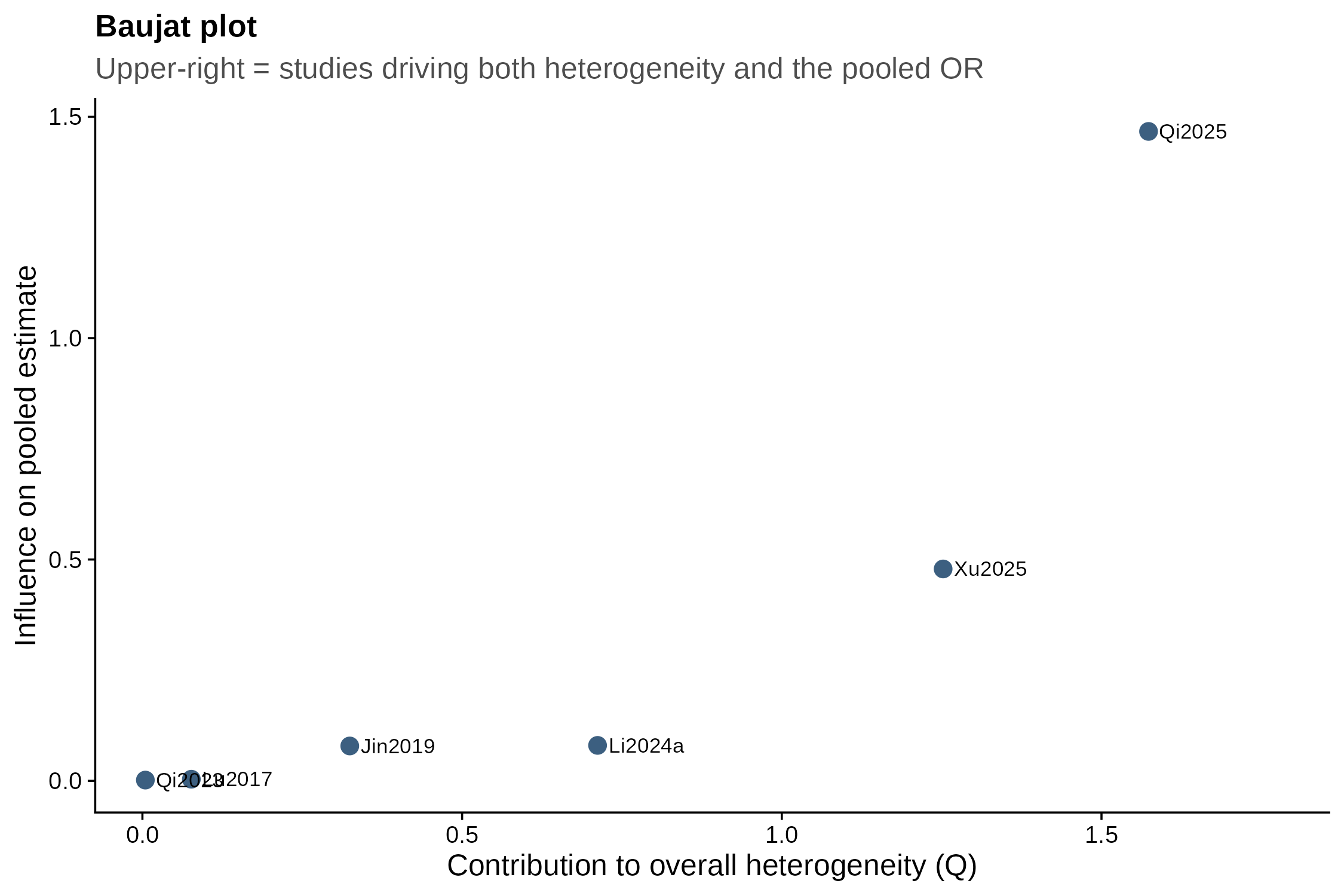
One influential study. Removing Xu2025 moves the pool to the null (OR ≈ 0.94); removing Qi2025 strengthens it (≈ 0.59). See sensitivity.
Confounded and heterogeneous. Li2024a bundles caspofungin with corticosteroid and a lower TMP dose; mortality timepoints and treatment timing vary across studies.
Incomplete corpus. Seven studies included by Yang et al. (2026) could not be retrieved — mostly Chinese-language papers and theses (CNKI/Wanfang); one (Wang-ZG-2019) was obtained and found ineligible (single-arm). Their absence limits power and may introduce language/selection bias.
Model adequacy and influence
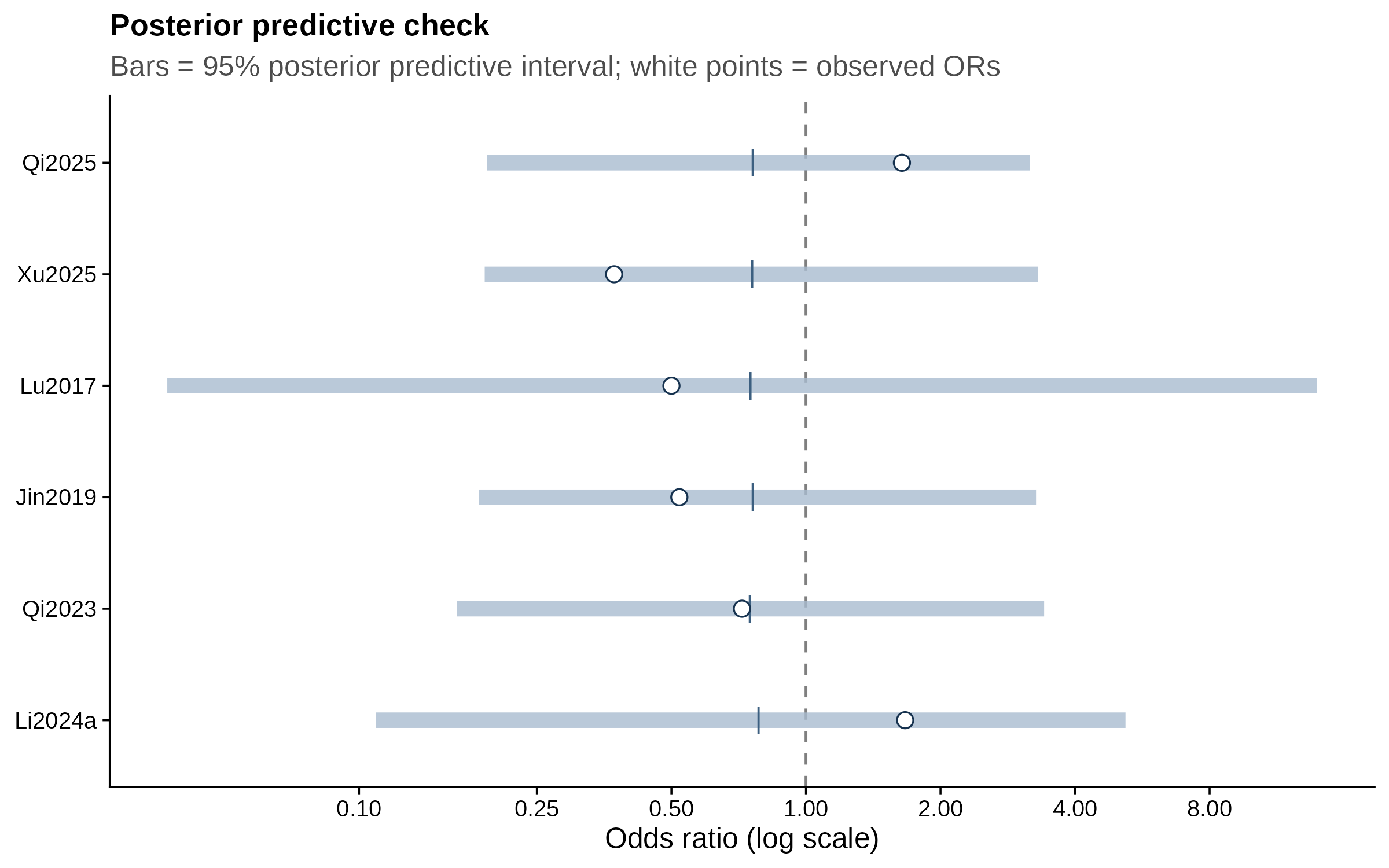
The random-effects model is an adequate description of the six studies: every observed odds ratio falls within its posterior predictive interval, and the modelled heterogeneity matches the data (omnibus Cochran’s Q posterior predictive p = 0.40). The residual fragility comes from two influential studies pulling in opposite directions rather than from a poorly fitting model. Full diagnostics are on the goodness-of-fit page.
Baujat plot — Qi2025 drives both the heterogeneity and the pooled estimate; Xu2025 is its counterweight.
Posterior predictive check — observed odds ratios (open points) all fall within their 95% posterior predictive intervals (bars).
Certainty of evidence (GRADE)
Applying GRADE to the primary outcome, all-cause mortality. As a body of non-randomised evidence, certainty starts at low and is then rated across the five domains below.
Show code
p_ctrl <-sum(ma$e_ref) /sum(ma$n_ref)orv <-or_ci(bm_sens)risk_from_or <-function(p, or) { o <- p / (1- p) * or; o / (1+ o) }tibble::tibble(Field =c("Outcome", "Participants (studies)", "Relative effect (OR)","Assumed risk, monotherapy", "Corresponding risk, combination (95% CrI)","Certainty"),Value =c("All-cause mortality (in-hospital / ~30-day)",sprintf("%d (6 observational studies)", sum(ma$n_comb + ma$n_ref)),fmt(bm_sens),sprintf("%.0f per 1000", p_ctrl *1000),sprintf("%.0f per 1000 (%.0f to %.0f)",risk_from_or(p_ctrl, orv[1]) *1000,risk_from_or(p_ctrl, orv[2]) *1000,risk_from_or(p_ctrl, orv[3]) *1000),"\u2295\u25cb\u25cb\u25cb Very low")) |> knitr::kable()
Field
Value
Outcome
All-cause mortality (in-hospital / ~30-day)
Participants (studies)
473 (6 observational studies)
Relative effect (OR)
0.76 (95% CrI 0.43–1.37)
Assumed risk, monotherapy
398 per 1000
Corresponding risk, combination (95% CrI)
335 per 1000 (220 to 475)
Certainty
⊕○○○ Very low
GRADE domain
Judgment
Rationale
Risk of bias
Serious (−1)
All studies non-randomised; confounding by indication; Li2024a critical (bundled co-interventions).
Inconsistency
Not serious
Credible intervals overlap and the direction is largely consistent; moderate I² (42%) is attributable to one influential study.
Indirectness
Not serious
Population, intervention, comparator and outcome match the review question directly.
Imprecision
Serious (−1)
Pooled CrI (0.43–1.37) spans meaningful benefit and harm; only 473 participants; wide prediction interval.
Publication bias
Suspected
Seven eligible studies (mostly Chinese-language) could not be retrieved; too few studies to test formally.
Overall certainty: very low (⊕◯◯◯). We are very uncertain whether adjunctive echinocandin reduces all-cause mortality in HIV-negative PCP. This rating is preliminary and should be finalised after dual ROBINS-I assessment.
Relation to the wider literature
Our result partly overlaps with Yang et al. (2026): their overall estimate is also null (OR 0.93), and their protective signal is confined to the initial-therapy subgroup (OR 0.50). Crucially, we could not reproduce timing as an effect modifier: within our six studies the initial and mixed subgroups are nearly identical (OR ≈ 0.70 vs 0.74) and a formal moderator test is null (QM(1) = 0.00, p = 0.99; see sensitivity). The apparent timing alignment reflects which studies are labelled “initial” rather than a genuine subgroup effect, and a direct significance test between the analyses is precluded by the ~9 studies they share. Yang’s extraction also contains errors we identified during verification (their Qi2025 numbers are from the ventilated subgroup; their “Wang 2019” treats a single-arm case series as a two-arm comparison), so it is a useful comparator rather than a ground truth.
Bottom line
Adjunctive echinocandin may reduce mortality in HIV-negative PCP, but the current evidence is too small, too observational, and too incomplete to be conclusive. Priorities before drawing a firm conclusion: complete dual human verification and formal ROBINS-I assessment, retrieve the missing Chinese-language studies, and — ultimately — randomized evidence.