Daptomycin and streptogramins

Russell E. Lewis

2026-05-29

Daptomycin and Streptogramins


Russell E. Lewis, Pharm.D., FCCP
Associate Professor of Infectious Diseases

{{< fa solid envelope size=1x >}} russelledward.lewis@unipd.it
Slides and course materials: www.idpadovaid.com

Learning Objectives


After this lecture, you should be able to:

  1. Describe the mechanism of action of daptomycin
  2. Understand daptomycin’s spectrum of activity and susceptibility testing
  3. Explain mechanisms of daptomycin resistance
  4. Apply appropriate dosing for different clinical scenarios
  5. Recognize adverse effects and monitoring requirements
  6. Identify clinical indications for daptomycin use

Part 1: Daptomycin basics

What is Daptomycin?


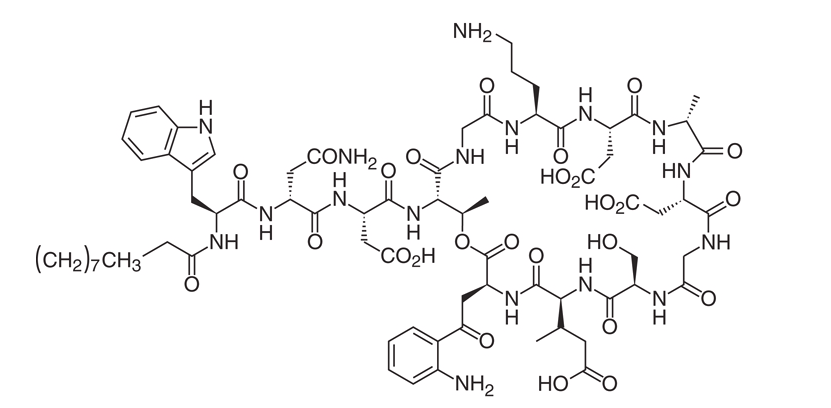
  • Cyclic lipopeptide antibiotic (1620.67 Da)
  • Produced by Streptomyces roseosporus
  • Discovered in the 1980s- Eli Lilly
  • FDA approved: 2003 (US), 2006 (Europe)

Chemical Structure


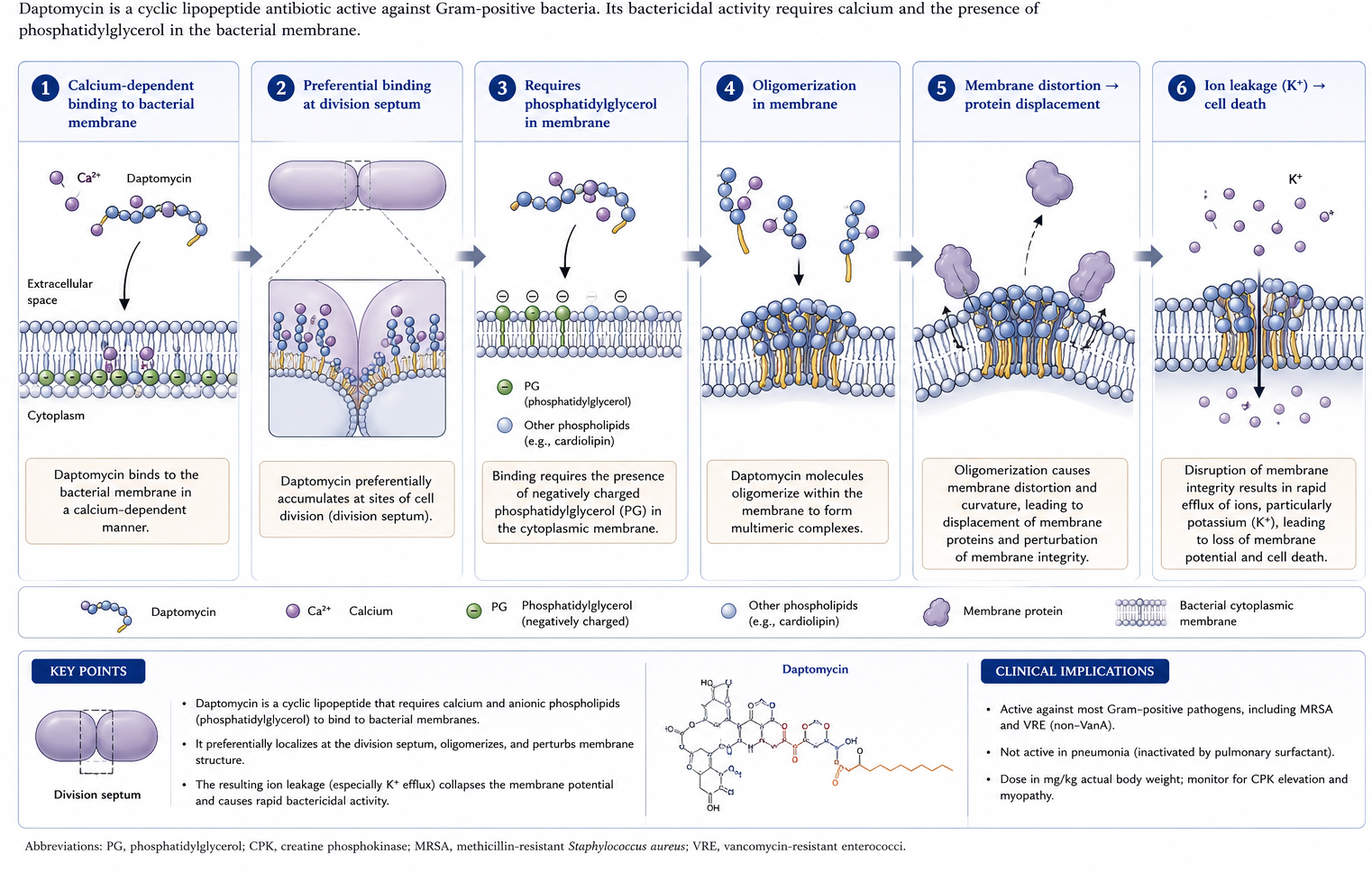
Mechanism of Action

Key Feature: Bactericidal without lysis


  • Kills bacteria without significant cell lysis
  • Results in reduced inflammatory response
  • Less release of proinflammatory mediators
  • Potential advantage in severe infections

Part 2: Antimicrobial spectrum

Spectrum of activity


Active against:

  • Staphylococcus aureus (MSSA, MRSA, VISA)
  • Coagulase-negative staphylococci
  • Enterococcus faecalis and E. faecium (including VRE)
  • Streptococci
  • Some gram-positive anaerobes

Organisms with variable/No activity


Variable activity:

  • Actinomyces spp. (MIC90 4-32 μg/mL)
  • Lactobacillus spp.
  • Some clostridial species

No activity:

  • Gram-negative organisms
  • Pulmonary infections (surfactant inactivation!)

Susceptibility testing challenges


Warning

Calcium-supplemented Mueller-Hinton broth is REQUIRED (50 μg/mL calcium concentration)

  • Disk diffusion: NOT recommended
  • Etest: Variable reproducibility
  • Broth microdilution: Preferred method
  • Significant interlaboratory variability exists

Susceptibility breakpoints


Organism Susceptible Intermediate Resistant
Staphylococci ≤1 μg/mL - >1 μg/mL
Streptococci ≤1 μg/mL - >1 μg/mL
E. faecalis (FDA) ≤4 μg/mL - -
E. faecium (CLSI 2019) - 2-4 μg/mL (SDD) ≥8 μg/mL

Part 3: Resistance Mechanisms

Resistance is uncommon but…


  • In vitro- resistance after serial passage is uncommon
  • Clinical resistance emerges during therapy
  • 6% of patients in pivotal bacteremia trial developed elevated MICs
  • Risk factors:
    • Deep-seated/undrained infections
    • Prior vancomycin exposure
    • Inadequate dosing

Phenotypic changes in resistant strains


  • Enhanced membrane fluidity
  • Increased positive surface charge
  • Resistance to depolarization
  • Reduced phosphatidylglycerol content
  • Increased pigment production
  • Decreased daptomycin binding

Genetic basis (S. aureus)


Key genes implicated:

  1. mprF - LPG synthase/flippase → increased surface charge
  2. yycFG/walKR - Cell envelope homeostasis
  3. vraSR - Cell wall stress response
  4. dlt operon - D-alanylation of teichoic acids
  5. pgsA/cls - Phospholipid metabolism


The “Seesaw effect”


Clinical Pearl

Daptomycin resistance often leads to increased β-lactam susceptibility

  • Basis for daptomycin + β-lactam combinations
  • Demonstrated in vitro and in animal models
  • Multiple β-lactams effective (oxacillin, ceftaroline, etc.)
  • May prevent emergence of resistance

Enterococcal resistance


  • LiaFSR system is central to resistance
  • Homologue of VraTSR in staphylococci
  • Cell envelope stress response system
  • Additional mutations in gdpD, cls genes
  • Resistance can emerge WITHOUT prior exposure

Part 4: Pharmacokinetics

Key PK parameters


Parameter Value
Half-life 7.3-9.6 hours
Protein binding 90-93%
Volume of distribution 92-117 mL/kg
Elimination Renal (unchanged)

Peak concentrations by dose


Dose (mg/kg) Peak (μg/mL) AUC (μg·hr/mL)
4 ~55 ~500
6 ~86 ~750
8 ~116 ~850
10 ~130 -
12 ~165 -

Tissue penetration


Good penetration:

  • Skin/soft tissue (~68% of plasma)
  • Cardiac vegetations (~50% of serum)

Poor penetration:

  • CNS (~2-6%)
  • Bone (variable)
  • Lungs (inactivated by surfactant!)

Part 5: Dosing

FDA-EMA approved dosing


Indication Dose Route
ABSSSI 4 mg/kg q24h IV
Bacteremia/Right-sided endocarditis 6 mg/kg q24h IV


BUT…


Experts recommend 8-12 mg/kg/day for serious infections!

Renal dose adjustment


CrCl Dose Adjustment
≥30 mL/min No adjustment
<30 mL/min Every 48 hours
Hemodialysis After HD, q48h
CRRT Variable - consider TDM

For patients on CRRT, there’s no uniform recommendation. Drug monitoring may be helpful. Some suggest 8 mg/kg q48h for CVVHDF. Monitor CPK more frequently in renal impairment.

Special populations


  • Obesity: No dose adjustment (use actual body weight)
  • Hepatic impairment: No adjustment (Child-Pugh B)
  • Pediatrics: FDA-approved, age-based dosing
  • Pregnancy: Category B (insufficient human data)

Part 6: Adverse effects

Muscle toxicity (Primary Concern)


  • CPK elevation (dose and duration dependent)
  • Mechanism: Direct membrane toxicity to myofibers
  • Risk factors:
    • Cmin ≥24.3 mg/L
    • Concurrent statin use
    • Renal impairment
    • Duration >7 days

CPK monitoring & management


When to Stop Daptomycin

  • CPK >1000 units/L WITH symptoms
  • CPK >2000 units/L (10× ULN) even without symptoms


Monitor:

  • Baseline CPK before starting
  • Weekly CPK (more often in renal impairment)
  • Weekly in patients on statins

Other adverse effects


Effect Frequency Notes
Eosinophilic pneumonia Rare After ~10 days; stop drug
Peripheral neuropathy 9% vs 2% Usually mild, reversible
GI symptoms Common Similar to comparators
Renal/hepatic Rare May be protective vs aminoglycosides


Drug Interactions


Minimal CYP450 interactions (not metabolized hepatically)

Monitor closely with:

  • Statins - increased CPK risk
  • PT/INR assays - may cause false elevation

Part 7: Clinical applications

FDA-approved Indications


  1. ABSSSI (Acute Bacterial Skin & Skin Structure Infections)
    • S. aureus (MSSA, MRSA)
    • Streptococcus pyogenes
    • E. faecalis (vancomycin-susceptible)
  2. S. aureus bacteremia & right-sided endocarditis

Off-label uses


  • VRE infections (bacteremia, endocarditis)
  • Left-sided endocarditis (with other agents)
  • Osteomyelitis
  • Prosthetic joint infections
  • CNS infections (limited data)

When to consider daptomycin


  • MRSA with vancomycin MIC ≥1.5-2 μg/mL
  • Vancomycin failure or intolerance
  • VRE infections
  • Concern for nephrotoxicity
  • Desire for once-daily dosing

When NOT to use daptomycin


Important

NEVER use for pneumonia!

Also avoid:

  • Known daptomycin-resistant organism
  • Prior daptomycin failure
  • Active rhabdomyolysis
  • Untreated source of infection

Part 8: Combination therapy strategies

Rationale for Combinations


  1. Prevent emergence of resistance
  2. Exploit the seesaw effect
  3. Enhance bactericidal activity
  4. Treat complicated/deep-seated infections

Daptomycin + β-lactam


Best supported combination:

  • Oxacillin/nafcillin
  • Ceftaroline (excellent data)
  • Ceftriaxone, cefotaxime
  • Ertapenem
  • Even ampicillin-sulbactam

Other combinations

Other combinations


Partner Evidence Comment
Gentamicin In vitro synergy Nephrotoxicity concern
Rifampin Variable May be antagonistic
Fosfomycin Emerging data Limited availability
Trimethoprim-sulfamethoxazole Case reports For MRSA

Case example: Persistent MRSA bacteremia

Case example: Persistent MRSA bacteremia


Scenario: Day 7 of vancomycin, blood cultures still positive

Approach: 1. Switch to high-dose daptomycin (8-10 mg/kg) 2. Add β-lactam (ceftaroline or oxacillin) 3. Ensure source control 4. Monitor CPK closely

Part 9: Quinupristin-Dalfopristin (Brief Overview)

Quinupristin-dalfopristin basics


  • Streptogramin B (30%) + Streptogramin A (70%)
  • Trade name: Synercid
  • Target: 50S ribosomal subunit
  • Limited clinical use due to:
    • Central line requirement
    • Arthralgias/myalgias
    • Infusion site reactions
    • Limited availability

Quinupristin-dalfopristin spectrum & dosing


Active against:

  • Most gram-positives EXCEPT E. faecalis
  • Some gram-negatives (H. influenzae, M. catarrhalis)

Dosing: 7.5 mg/kg IV q12h (1-hour infusion)

No renal adjustment needed

Quinupristin-dalfopristin: Why it’s rarely used


  • Arthralgias/myalgias (up to 50%)
  • Severe infusion site reactions
  • Requires central venous access
  • CYP3A4 drug interactions
  • Limited availability in US
  • Better alternatives exist (linezolid, daptomycin)

Summary & Key Takeaways

Daptomycin key points


  1. Calcium-dependent cyclic lipopeptide
  2. Bactericidal without cell lysis
  3. Spectrum similar to vancomycin but active against VISA/VRE
  4. Never use for pneumonia (surfactant inactivation)
  5. Monitor CPK - stop if elevated with symptoms
  6. Use high doses (8-12 mg/kg) for serious infections

Clinical pearls


Tip

  • Consider daptomycin when vancomycin MIC ≥1.5-2 μg/mL
  • Add β-lactam for persistent bacteremia
  • The “seesaw effect” makes β-lactam combinations logical
  • Renal dosing: extend interval, don’t reduce dose
  • Check CPK baseline and weekly; more often with renal impairment or statins

Questions to Consider


  1. Why can’t daptomycin be used for pneumonia?
  2. What is the seesaw effect and how is it clinically useful?
  3. When should you suspect daptomycin resistance?
  4. What CPK level should prompt discontinuation?
  5. Why is high-dose daptomycin preferred for serious infections?

References


Arbeit RD, Maki D, Tally FP, et al. The safety and efficacy of daptomycin for the treatment of complicated skin and skin-structure infections. Clinical Infectious Diseases 2004;38:1673–81.
Ardura MI, Mejias A, Katz KS, et al. Daptomycin therapy for invasive gram-positive bacterial infections in children. Pediatric Infectious Disease Journal 2007;26:1128–32.
Arias CA, Panesso D, McGrath DM, Qin X, et al. Genetic basis for in vivo daptomycin resistance in enterococci. New England Journal of Medicine 2011a;365:892–900.
Arias CA, Panesso D, McGrath DM, Qin X, Mojica MF, et al. Genetic basis for in vivo daptomycin resistance in enterococci. New England Journal of Medicine 2011b;365:892–900.
Barber KE, Werth BJ, Ireland CE, Rybak MJ. Potent synergy of ceftaroline plus daptomycin against methicillin-resistant staphylococcus aureus with reduced vancomycin susceptibility. Antimicrobial Agents and Chemotherapy 2015;59:4329–32.
Benvenuto M, Benziger DP, Yankelev S, Vigliani G. Pharmacokinetics and tolerability of daptomycin at doses up to 12 milligrams per kilogram of body weight once daily in healthy volunteers. Antimicrobial Agents and Chemotherapy 2006;50:3245–9.
Bhavnani SM, Rubino CM, Ambrose PG, Drusano GL. Daptomycin exposure and the probability of elevations in the creatine phosphokinase level. Clinical Infectious Diseases 2010;50:1568–74.
Campeau SA, Schuetz AN, Humphries RM. Variability of daptomycin MIC values for staphylococcus aureus and enterococcus species in reference and clinical microbiology laboratories. Journal of Clinical Microbiology 2018;56:e01598–17.
Clinical and Laboratory Standards Institute. Performance standards for antimicrobial susceptibility testing. 29th ed. CLSI; 2019.
Cottagnoud P, Pfister M, Acosta F, et al. Daptomycin is highly efficacious against penicillin-resistant and penicillin- and quinolone-resistant pneumococci in experimental meningitis. Antimicrobial Agents and Chemotherapy 2004;48:3928–33.
Credito K, Lin G, Appelbaum PC. Activity of daptomycin alone and in combination with rifampin and gentamicin against staphylococcus aureus assessed by time-kill methodology. Antimicrobial Agents and Chemotherapy 2007;51:1504–7.
Dare RK, Tewell C, Harris B, et al. Effect of statin coadministration on the risk of daptomycin-associated myopathy. Clinical Infectious Diseases 2018;67:1356–63.
Dhand A, Bayer AS, Pogliano J, Yang SJ, et al. Use of antistaphylococcal β-lactams to increase daptomycin activity in eradicating persistent bacteremia due to methicillin-resistant staphylococcus aureus. Clinical Infectious Diseases 2011;53:158–63.
Dvorchik BH, Brazier D, DeBruin MF, Arbeit RD. Daptomycin pharmacokinetics and safety following administration of escalating doses once daily to healthy subjects. Antimicrobial Agents and Chemotherapy 2003;47:1318–23.
Falcone M, Russo A, Cassetta MI, et al. Variability of pharmacokinetic parameters in patients receiving different dosages of daptomycin: Is therapeutic drug monitoring necessary? Journal of Infection and Chemotherapy 2013;19:732–9.
Fowler VG, Boucher HW, Corey GR, Abrutyn E, Karchmer AW, et al. Daptomycin versus standard therapy for bacteremia and endocarditis caused by staphylococcus aureus. New England Journal of Medicine 2006;355:653–65.
Gonzalez D, Bradley JS, Blumer J, et al. Daptomycin in children: Report of a phase 3 efficacy and safety trial for skin and skin structure infections. Pediatric Infectious Disease Journal 2017;36:749–56.
Howden BP, McEvoy CR, Allen DL, Chua K, et al. Evolution of multidrug resistance during staphylococcus aureus infection involves mutation of the essential two component regulator WalKR. PLoS Pathogens 2011;7:e1002359.
Humphries RM, Kelesidis T, Tewhey R, Rose WE, Schork N, et al. Genotypic and phenotypic evaluation of the evolution of high-level daptomycin nonsusceptibility in vancomycin-resistant enterococcus faecium. Antimicrobial Agents and Chemotherapy 2011;56:6051–5.
Jung D, Rozek A, Okon M, Hancock RE. Structural transitions as determinants of the action of the calcium-dependent antibiotic daptomycin. Chemistry and Biology 2004;11:949–57.
Khadzhynov D, Slowinski T, Lieker I, et al. Plasma pharmacokinetics of daptomycin in critically ill patients with renal failure and undergoing CVVHD. International Journal of Clinical Pharmacology and Therapeutics 2011;49:656–65.
Khan A, Tran TT, Dinh AQ, et al. Antimicrobial sensing coupled with cell membrane remodeling mediates antibiotic resistance and virulence in enterococcus faecalis. Proceedings of the National Academy of Sciences 2019;116:26925–32.
Kielstein JT, Eugbers C, Bode-Böger SM, et al. Dosing of daptomycin in intensive care unit patients with acute kidney injury undergoing extended dialysis. Intensive Care Medicine 2014;40:1735–42.
Kullar R, Casapao AM, Davis SL, et al. A multicentre evaluation of the effectiveness and safety of high-dose daptomycin for the treatment of infective endocarditis. Journal of Antimicrobial Chemotherapy 2013;68:2921–6.
Kullar R, Davis SL, Taylor TN, et al. Effects of targeting higher vancomycin trough levels on clinical outcomes and costs in a matched patient cohort. Pharmacotherapy 2011;32:195–201.
Lee DH, Palermo B, Chowdhury M. Successful treatment of methicillin-resistant staphylococcus aureus meningitis with daptomycin. Clinical Infectious Diseases 2008;47:588–90.
Louie A, Kaw P, Liu W, Jumbe N, et al. Pharmacodynamics of daptomycin in a murine thigh model of staphylococcus aureus infection. Antimicrobial Agents and Chemotherapy 2001;45:845–51.
McConnell HL, Perris EE, Lowry C, et al. Risk factors for myopathy with concomitant statin and daptomycin use. Open Forum Infectious Diseases 2017;4:S316.
Mehta S, Singh C, Plata KB, Chanda PK, et al. Β-lactams increase the antibacterial activity of daptomycin against clinical methicillin-resistant staphylococcus aureus strains and prevent selection of daptomycin-resistant derivatives. Antimicrobial Agents and Chemotherapy 2012;56:6192–200.
Mishra NN, Bayer AS, Weidenmaier C, Grber T, et al. Phenotypic and genotypic characterization of daptomycin-resistant methicillin-resistant staphylococcus aureus strains. Antimicrobial Agents and Chemotherapy 2012;56:4324–32.
Moore CL, Osaki-Kiyan P, Haque NZ, et al. Daptomycin versus vancomycin for bloodstream infections due to methicillin-resistant staphylococcus aureus with a high vancomycin minimum inhibitory concentration. Clinical Infectious Diseases 2012;54:51–8.
Müller A, Wenzel M, Strahl H, Zervosen A, Campagne S, et al. Daptomycin inhibits cell envelope synthesis by interfering with fluid membrane microdomains. Proceedings of the National Academy of Sciences 2016;113:E7077–86.
Murray KP, Zhao JJ, Davis SL, et al. Early use of daptomycin versus vancomycin for methicillin-resistant staphylococcus aureus bacteremia with vancomycin minimum inhibitory concentration >1 mg/l: A matched cohort study. Clinical Infectious Diseases 2013;56:1562–9.
Peleg AY, Miyakis S, Ward DV, Earl AM, et al. Whole genome characterization of the mechanisms of daptomycin resistance in clinical and laboratory derived isolates of staphylococcus aureus. PLoS ONE 2012;7:e28316.
Pogliano J, Pogliano N, Silverman JA. Daptomycin-mediated reorganization of membrane architecture causes mislocalization of essential cell division proteins. Journal of Bacteriology 2012;194:4494–504.
Rose WE, Berti AD, Hatch JB, Rybak MJ. Relationship of in vitro synergy and treatment outcome with daptomycin plus rifampin in patients with invasive methicillin-resistant staphylococcus aureus infections. Antimicrobial Agents and Chemotherapy 2012;57:3450–2.
Sakoulas G, Alder J, Thauvin-Eliopoulos C, Moellering RC, Eliopoulos GM. Induction of daptomycin heterogeneous susceptibility in staphylococcus aureus by exposure to vancomycin. Antimicrobial Agents and Chemotherapy 2006;50:1581–5.
Sakoulas G, Bayer AS, Pogliano J, Tsuji BT, et al. Ampicillin enhances daptomycin- and cationic host defense peptide-mediated killing of ampicillin- and vancomycin-resistant enterococcus faecium. Antimicrobial Agents and Chemotherapy 2014a;56:838–44.
Sakoulas G, Okumura CY, Thiber W, et al. Nafcillin enhances innate immune-mediated killing of methicillin-resistant staphylococcus aureus. Journal of Molecular Medicine 2014b;92:139–49.
Silverman JA, Mortin LI, VanPraagh AD, et al. Inhibition of daptomycin by pulmonary surfactant: In vitro modeling and clinical impact. Journal of Infectious Diseases 2007;191:2149–52.
Silverman JA, Oliver N, Andrew T, Li T. Resistance studies with daptomycin. Antimicrobial Agents and Chemotherapy 2001;45:1799–802.
Silverman JA, Perlmutter NG, Shapiro HM. Correlation of daptomycin bactericidal activity and membrane depolarization in staphylococcus aureus. Antimicrobial Agents and Chemotherapy 2003;47:2538–44.
Tran TT, Panesso D, Mishra NN, Mileykovskaya E, et al. Daptomycin-resistant enterococcus faecalis diverts the antibiotic molecule from the division septum and remodels cell membrane phospholipids. MBio 2013;4:e00281–13.
Traunmüller F, Schintler MV, Metzler J, et al. Soft tissue and bone penetration abilities of daptomycin in diabetic patients with bacterial foot infections. Journal of Antimicrobial Chemotherapy 2010;65:1252–7.
US Food and Drug Administration. Cubicin (daptomycin for injection) prescribing information. FDA; 2020.
Wise R, Gee T, Andrews JM, Dvorchik B, Marshall G. Pharmacokinetics and inflammatory fluid penetration of intravenous daptomycin in volunteers. Antimicrobial Agents and Chemotherapy 2002;46:31–3.
Yang SJ, Kreiswirth BN, Sakoulas G, Yeaman MR, Bayer AS. Enhanced expression of dltABCD is associated with the development of daptomycin nonsusceptibility in a clinical endocarditis isolate of staphylococcus aureus. Journal of Infectious Diseases 2009;200:1916–20.
Yang SJ, Nast CC, Mishra NN, Yeaman MR, et al. Cell wall thickening is not a universal accompaniment of the daptomycin nonsusceptibility phenotype in staphylococcus aureus. Antimicrobial Agents and Chemotherapy 2010;54:3422–6.